Key takeaways
- A good AI chat assistant answers customer questions instantly, at any hour, using information you’ve approved.
- It should only answer from your own content — services, prices, policies and FAQs — and say when it doesn’t know.
- Businesses are responsible for what their chatbot says: in 2024 a Canadian tribunal held Air Canada liable for its chatbot’s wrong advice.
- Since 2 August 2026 the EU AI Act requires people to be told they’re interacting with AI unless it’s obvious.
- Measure success by enquiries, bookings and saved time, not by the number of chats.
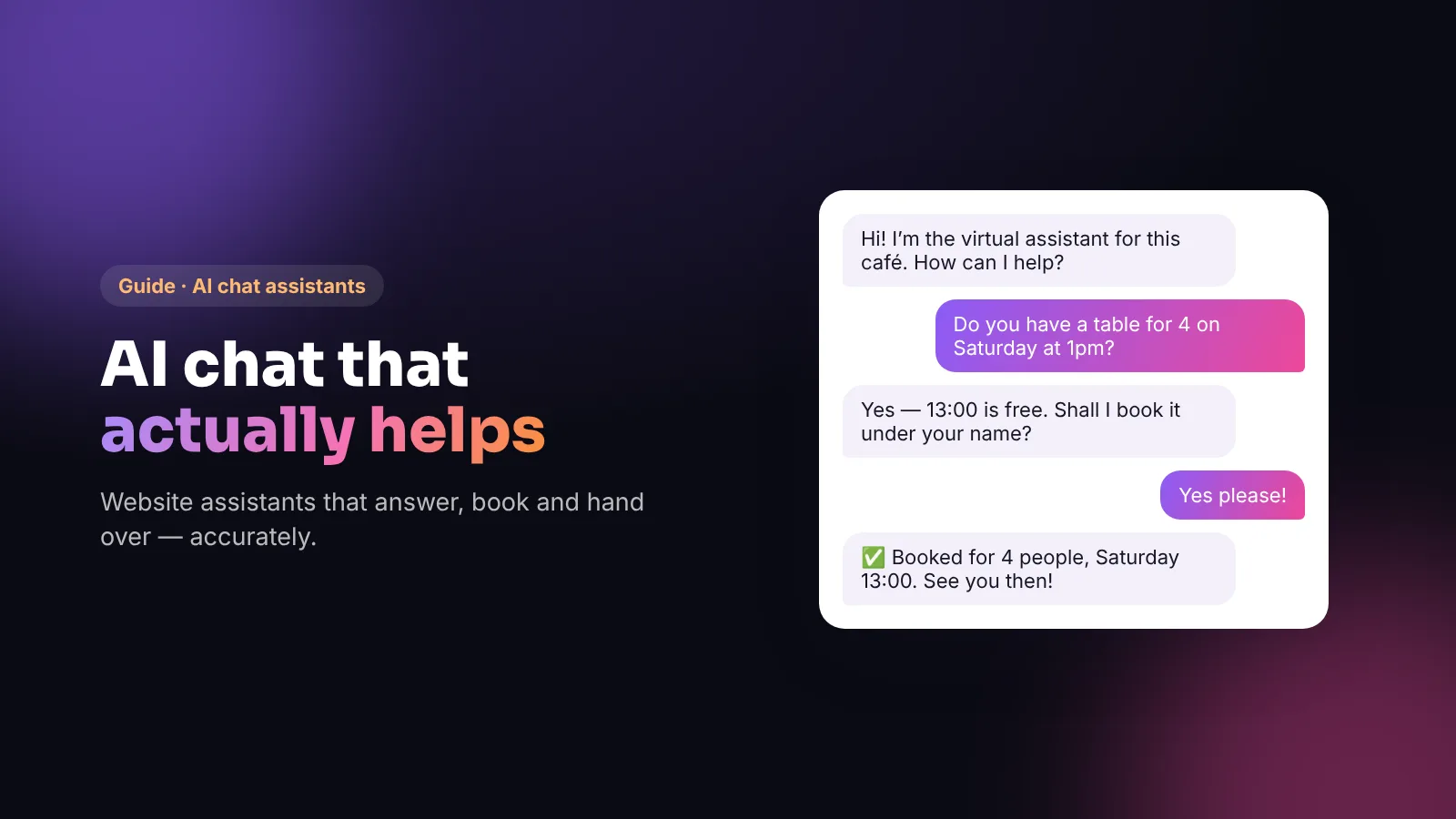
Website chat used to mean clunky menus (“Press 1 for opening hours”) or a live chat box nobody had time to answer. Modern AI assistants are different: they understand normal questions, reply naturally and can take actions such as booking a table or collecting a quote request. Done well, they turn more visitors into customers. Done badly, they invent answers and frustrate people. Here’s how to get it right.
What an AI chat assistant can do
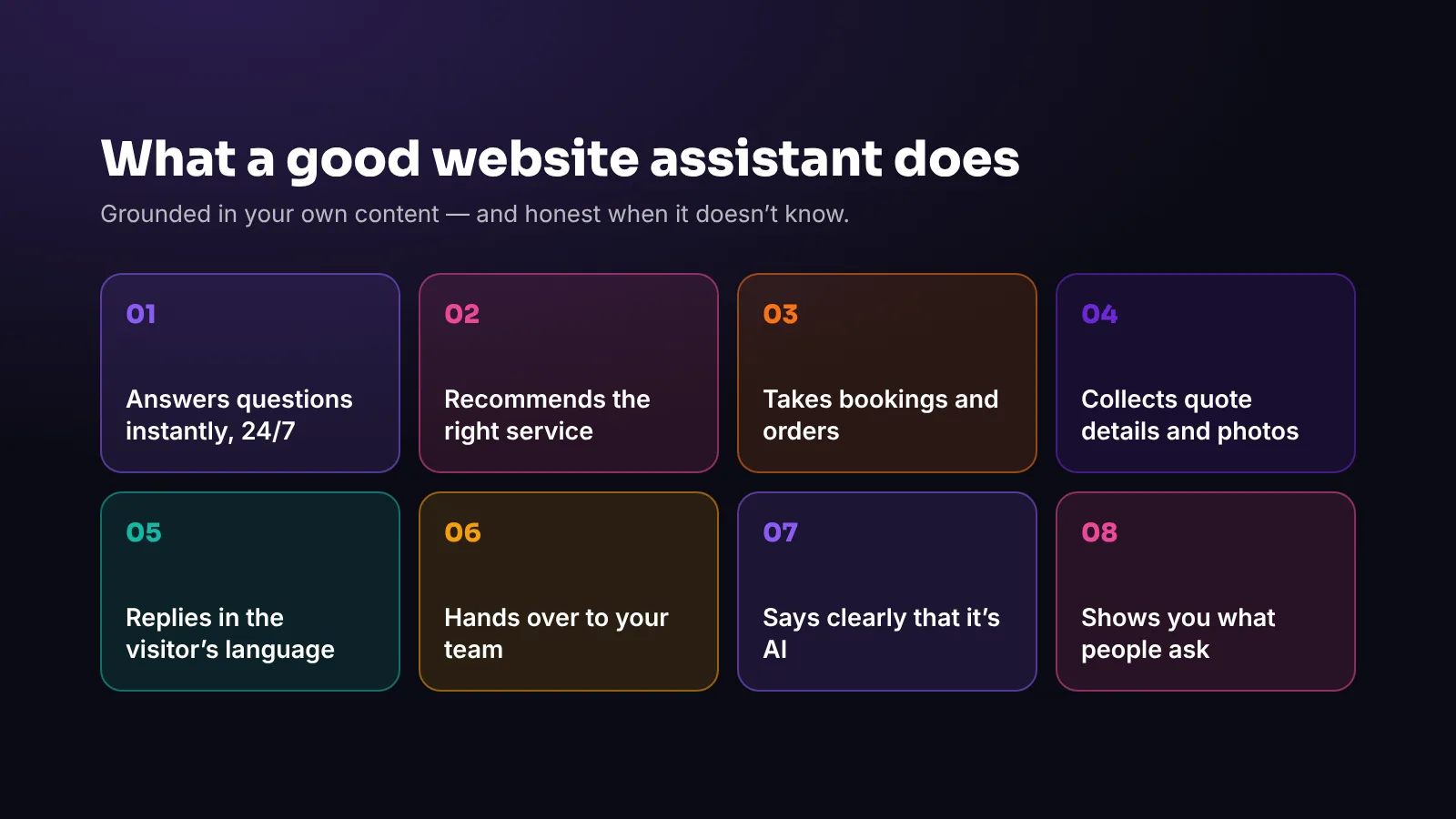
- Answer questions about services, prices, opening hours, delivery, parking and policies.
- Recommend the right option — which treatment, which package, which product — based on a few questions.
- Take bookings or orders when connected to your booking system or shop.
- Collect enquiries with the details you need (date, budget, postcode, photos) and send them to your inbox or CRM.
- Work in several languages, answering in the visitor’s language.
- Hand over to a person by email, phone or messaging when the question needs it.
Grounded answers: the most important design choice
The biggest risk with AI chat is a confident but wrong answer — a price you don’t charge, a policy you don’t have, an opening time that’s changed. The fix is grounding: the assistant answers from a curated knowledge base of your content, not from general internet knowledge.
In practice that means:
- A single source of truth: services, prices, hours, policies and FAQs, kept up to date.
- Clear instructions on what it must not discuss (medical advice, legal advice, competitors’ prices) and what to say instead.
- A fallback: “I’m not sure about that — would you like me to pass your question to the team?”
- Regular reviews of real conversations to spot gaps and errors.
A cautionary tale
In February 2024 the Civil Resolution Tribunal of British Columbia ruled in *Moffatt v. Air Canada* that the airline was responsible for incorrect information its website chatbot gave a customer about bereavement fares. The airline argued the chatbot was responsible for its own actions; the tribunal disagreed. The lesson for every business is simple: your chatbot speaks for you, so control what it says.
Where chat assistants pay off
- Restaurants and cafés: menus, allergens (with careful, approved wording), bookings, group enquiries.
- Salons and clinics: which treatment is right, prices, aftercare, booking links.
- Trades and services: collecting job details and photos before a quote.
- Shops: product questions, sizes, delivery and returns.
- Hotels and holiday lets: check-in times, facilities, local tips — in many languages.
How to set one up
- Pick three jobs it must do brilliantly — for example answer questions, collect enquiries and book appointments.
- Gather your content: your website, price list, policies and the 30 questions customers ask most.
- Write the rules: tone of voice, topics to avoid, when to hand over, what to collect.
- Connect your tools: booking system, email, CRM or shop.
- Test with tricky questions: ambiguous wording, other languages, out-of-scope requests.
- Launch, then review weekly for the first month.
Design tips customers notice
- Say what it is in the first message: “Hi! I’m Viraluna Café’s virtual assistant — I can help with bookings and questions.”
- Offer quick buttons for the most common questions, while still accepting free text.
- Keep replies short and link to the right page for detail.
- Don’t pop up aggressively. A small, clearly labelled button is enough.
- Make it accessible: keyboard-friendly, readable, with good contrast and screen-reader labels.
Privacy and the rules
This is general information, not legal advice.
- Transparency (EU): the AI Act requires AI systems that interact with people to make clear they are AI, unless obvious. This has applied since 2 August 2026.
- Personal data (UK and EU GDPR): chat conversations often include names, contact details and sometimes sensitive information. Explain this in your privacy notice, collect only what you need, keep it secure and delete it when it’s no longer needed.
- Cookies and tracking: if the chat widget sets non-essential cookies, it needs consent under the UK’s PECR or EU ePrivacy rules.
- Choose providers carefully: check where data is processed, whether conversations are used to train models, and what data processing terms are available.
How to measure success
- Enquiries and bookings started in the chat
- Questions answered without staff involvement
- Hand-overs to staff, and why they happened
- Unanswered questions (each one is content to add)
- Customer feedback and ratings, where collected
Frequently asked questions
Are AI chatbots worth it for small businesses?
They can be, when they answer from your own approved content, connect to bookings or enquiries, and hand over to a person when needed. Start with a few clear jobs and measure bookings and saved time.
Can a chatbot give wrong answers?
Yes, if it isn’t grounded in your own information. Limit it to your approved content, give it a clear fallback and review conversations regularly. Businesses are responsible for what their chatbot tells customers.
Do I need to tell visitors they are chatting with AI?
In the EU, yes, unless it’s obvious — the AI Act transparency duty has applied since 2 August 2026. Elsewhere it’s still best practice. A clear introduction in the first message is enough.
Is a website chatbot GDPR compliant?
It can be. Tell visitors how chat data is used in your privacy notice, collect only what you need, use providers with proper data processing terms and get consent for any non-essential cookies.
Can the chatbot book appointments?
Yes, if it’s connected to your booking system or calendar. It can also collect details and send booking links.
The bottom line
A well-built AI chat assistant is like a knowledgeable team member who never sleeps — as long as you control what it knows and what it says. Ground it in your content, be open that it’s AI, connect it to the actions that matter and keep reviewing.
Viraluna Studio builds private, grounded AI assistants for websites and messaging channels, and AI voice agents for your phone. Explore AI applications or read our guide to AI voice agents.