Key takeaways
- An AI voice agent answers your phone in a natural voice, handles common questions, books appointments and takes messages — at any hour.
- It works best for predictable calls: opening hours, prices, availability, bookings, changes and directions.
- A good set-up always offers a route to a person for urgent, sensitive or complex calls.
- In the EU, the AI Act has required since 2 August 2026 that people are told when they’re interacting with an AI system. Tell callers clearly, wherever you are.
- Start small: after-hours and busy-line calls first, then expand once you’ve listened to real calls.
For many local businesses the phone is still the most valuable channel there is. The person calling a salon, clinic, garage or restaurant usually wants to book *now*. If nobody answers, many won’t leave a voicemail — they’ll simply call the next business on the list. AI voice agents have become good enough to change that, and affordable enough for small businesses. This guide explains how they work, where they help, where they don’t, and how to introduce one without annoying your customers.
What is an AI voice agent?
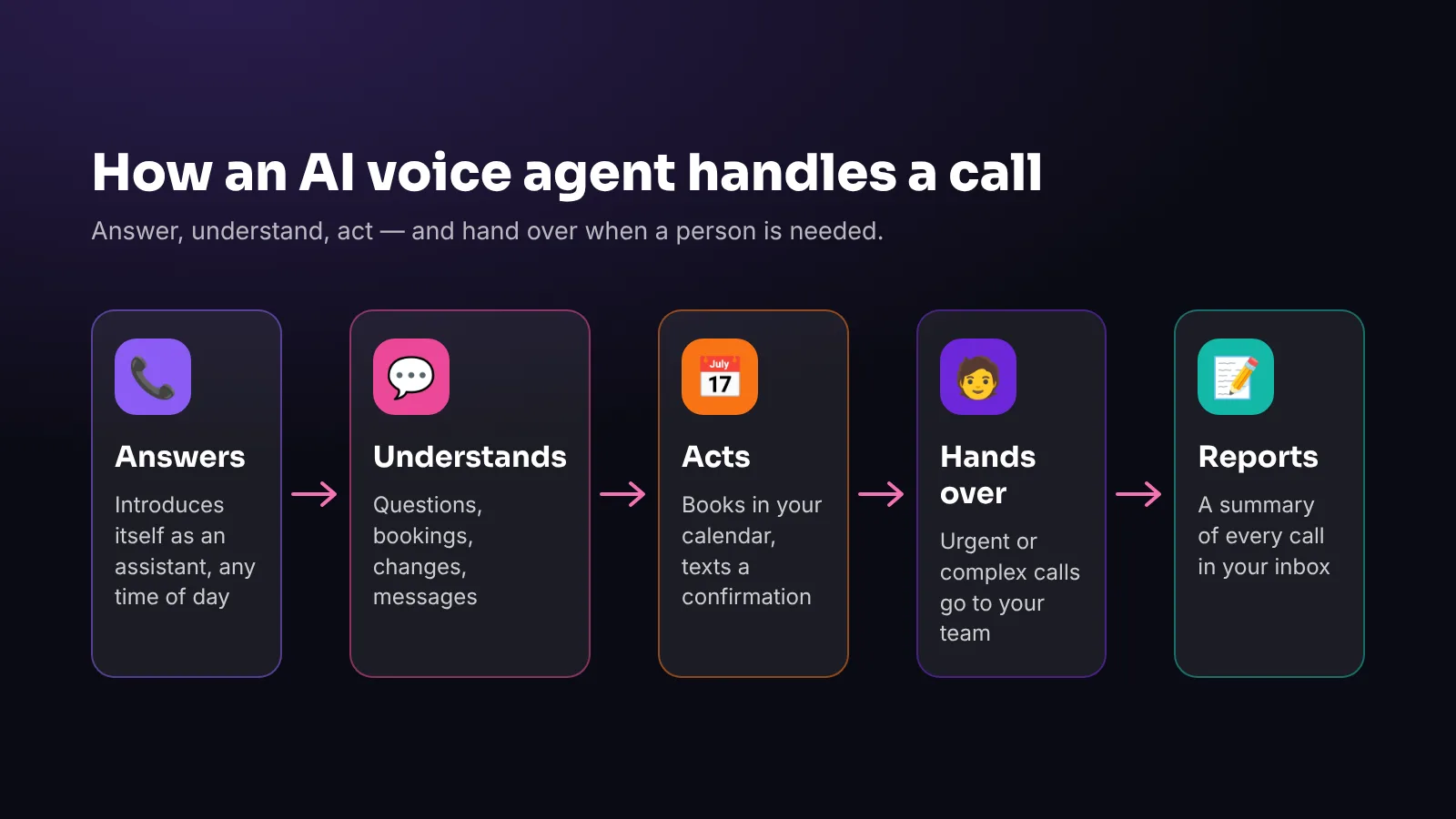
An AI voice agent (also called an AI receptionist or AI phone assistant) is software that answers phone calls and holds a spoken conversation. Under the surface it combines three things:
- Speech recognition — turning what the caller says into text.
- A language model — understanding the request and deciding what to say or do, using information about *your* business.
- Speech synthesis — replying in a natural-sounding voice.
The useful part is what it’s connected to. A voice agent linked to your booking system can check real availability and book an appointment. Linked to your email or messaging, it can send you a summary of every call. Linked to your phone system, it can transfer a caller to a member of staff.
What it can do well
- Answer every call, including at night, at weekends and when every line is busy.
- Answer common questions: opening hours, prices, parking, directions, what’s included, how long a treatment takes.
- Book, move and cancel appointments directly in your calendar or booking system.
- Take detailed messages and send them to you by email or text, with the caller’s number and what they need.
- Qualify enquiries: ask the questions you’d ask (date, number of people, type of job, postcode) before passing them on.
- Speak several languages, which matters for tourist areas and multilingual cities across Europe.
- Send follow-ups, such as a confirmation text with a booking link or address.
What it shouldn’t do
- Handle emergencies or sensitive situations. Medical, legal, safety or distressing calls need a person and clear escalation.
- Make promises outside your rules. It should only quote prices, discounts and policies you’ve approved.
- Pretend to be human. Being open is both the right thing to do and, in the EU, a legal requirement (see below).
- Trap callers. There must always be a simple way to reach a person or leave a message.
Where it helps most
- Salons, barbers and beauty businesses — the phone rings mid-appointment, with wet hands and a client in the chair.
- Clinics, physios and dentists — bookings, changes and reminders at peak times.
- Restaurants — table bookings and the same questions about allergens, parking and opening times (allergen questions should be routed carefully — see below).
- Trades and home services — capturing job details while you’re on site.
- Hotels and holiday lets — calls from other time zones and in other languages.
A simple way to work out the value
You don’t need complex maths. Estimate:
- How many calls you miss each week (your phone system or provider can often tell you).
- What share of those callers would have become customers.
- The average value of a new customer.
Multiply them, then multiply by about 4.3 for a month. A business that misses 10 calls a week, converts a third of callers and earns €60 per new customer is leaving roughly €860 a month unanswered. Try your own numbers with the calculator on our AI voice agents page.
How to set one up well
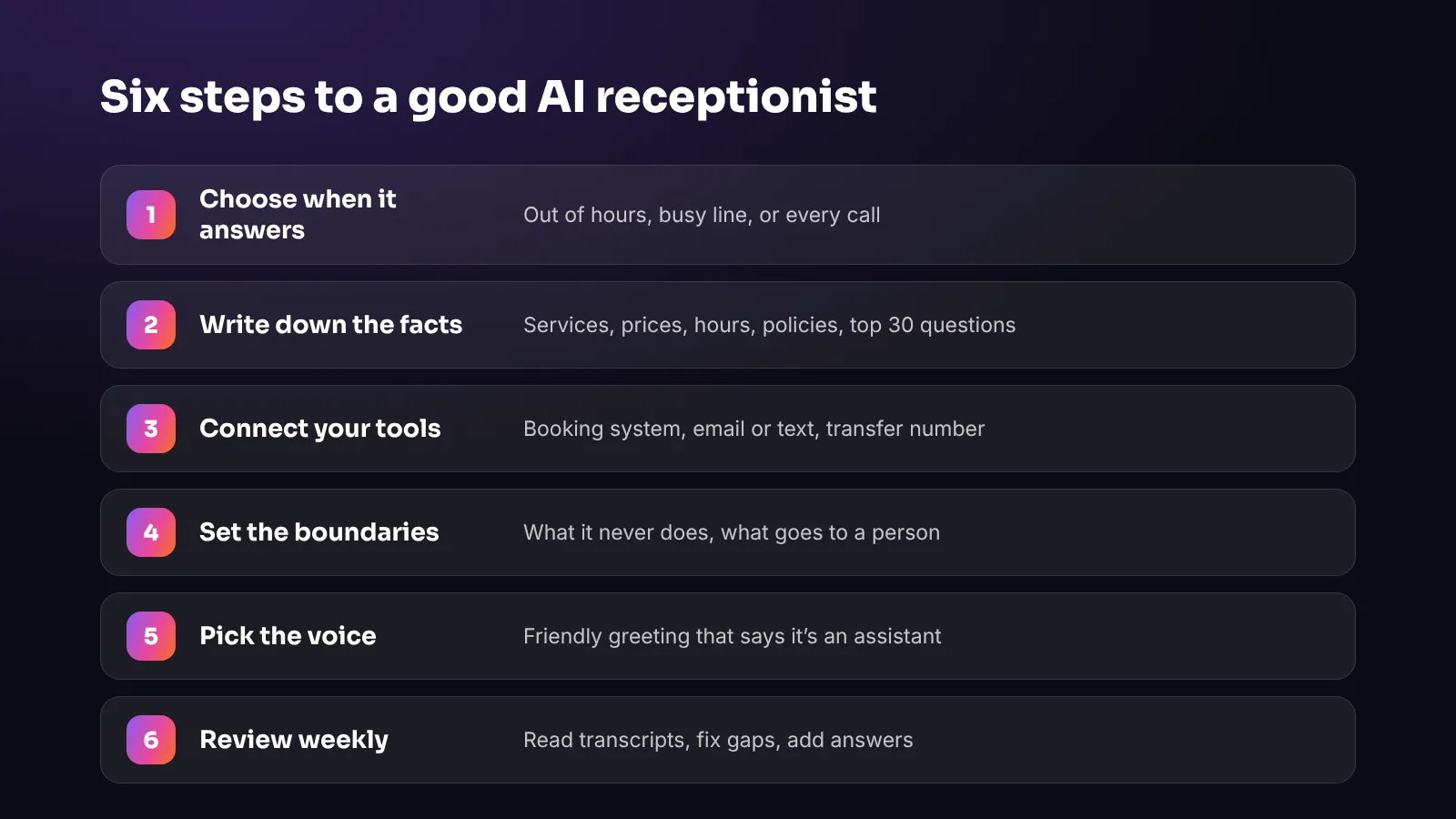
- Decide when it answers. Out of hours, when the line is busy, after a set number of rings — or all calls. Many businesses start with out-of-hours and overflow.
- Write down the facts. Services, prices, hours, policies, location, parking, cancellation rules and your top 30 questions with the answers you’d give.
- Connect the tools. Booking system or calendar, email or messaging for summaries, and a transfer number for staff.
- Set the boundaries. What it must never do, which calls go straight to a person, and what to say when it doesn’t know.
- Choose the voice and greeting. Friendly, clear, matching your brand — and introducing itself as an assistant.
- Test with real scenarios, then review calls weekly. Listen to recordings or read transcripts, fix gaps and add new answers.
The rules: telling callers it’s AI
This is general information, not legal advice.
- EU: the AI Act (Regulation (EU) 2024/1689) requires AI systems that interact directly with people to be designed so that people are informed they’re interacting with AI, unless it’s obvious. This transparency duty has applied since 2 August 2026. A short line in the greeting — “Hi, I’m the virtual assistant for…” — does the job.
- UK: there’s no single AI law, but consumer protection law prohibits misleading practices, and UK GDPR applies to the personal data in calls. Being upfront is the safe and honest approach.
- Recording and transcripts: if calls are recorded or transcribed, tell callers at the start, explain why in your privacy notice, keep recordings only as long as you need them and choose providers with proper data protection terms.
- Special information: health, allergy or other sensitive information needs extra care. Route these questions to a person or give approved, cautious wording.
What about cost?
Costs usually combine a set-up project (configuration, integrations, testing) and a running cost based on minutes or calls. Compare that with the value of the calls you’re missing and the staff time spent answering routine questions. Ask any provider to be clear about per-minute pricing, phone number costs and what happens if call volumes spike.
Frequently asked questions
What is an AI receptionist?
An AI receptionist is a voice agent that answers your business phone, answers common questions, books appointments and takes messages using information about your business, and passes calls to a person when needed.
Do I have to tell callers they are speaking to an AI?
In the EU, yes: since 2 August 2026 the AI Act requires people to be informed when they interact with an AI system, unless it’s obvious. In the UK it is strongly recommended to avoid misleading customers. A clear line in the greeting is enough.
Can an AI voice agent book appointments?
Yes, when it’s connected to your booking system or calendar. It can check availability, book, move and cancel appointments and send confirmations.
Will customers hate talking to an AI?
Most callers simply want a quick answer or a booking. Keep the agent friendly and fast, let it do the routine work, and always offer a person for anything else. That’s a better experience than an unanswered phone.
Can I keep my existing phone number?
Usually, yes. Calls can be forwarded to the voice agent all the time, outside opening hours or only when your line is busy.
The bottom line
An AI voice agent won’t replace the warmth of your team, but it can make sure no customer goes unanswered. Start with the calls you’re currently missing, be open with callers, set firm boundaries, and review what it does every week.
Viraluna Studio designs, builds and looks after AI voice agents for businesses across the UK and Europe — connected to your booking system, in your languages, with privacy built in. Explore AI voice agents or read about AI chat assistants for your website.