Key takeaways
- Start with what you’ll sell and who to, then choose the platform — not the other way round.
- Make checkout fast and trusted: cards, Apple Pay and Google Pay, clear delivery costs and no surprises.
- Online consumers in the UK and EU generally have a 14-day right to cancel distance purchases; tell them how.
- For EU cross-border sales to consumers above €10,000 a year in total, VAT is due in the customer’s country — the One-Stop Shop (OSS) simplifies this.
- Since 28 June 2025 the European Accessibility Act has applied to e-commerce in the EU (micro-enterprises are exempt for services).
Selling online lets a local business earn while the shop is closed, reach customers further away and offer gift cards, classes and subscriptions. It’s also easier than ever to start — but a few decisions early on make the difference between a shop that sells and one that sits quietly. Here’s the path we take with clients.
Step 1: Decide what to sell online
Not everything you sell in person works online. Start with products that are:
- Easy to ship or collect (size, weight, fragility, shelf life)
- Clearly described and photographed
- Profitable after delivery, packaging and payment fees
Don’t forget non-physical products: gift cards, vouchers, classes, workshops, memberships and subscriptions often sell brilliantly for cafés, salons, gyms and studios.
Step 2: Choose the right platform
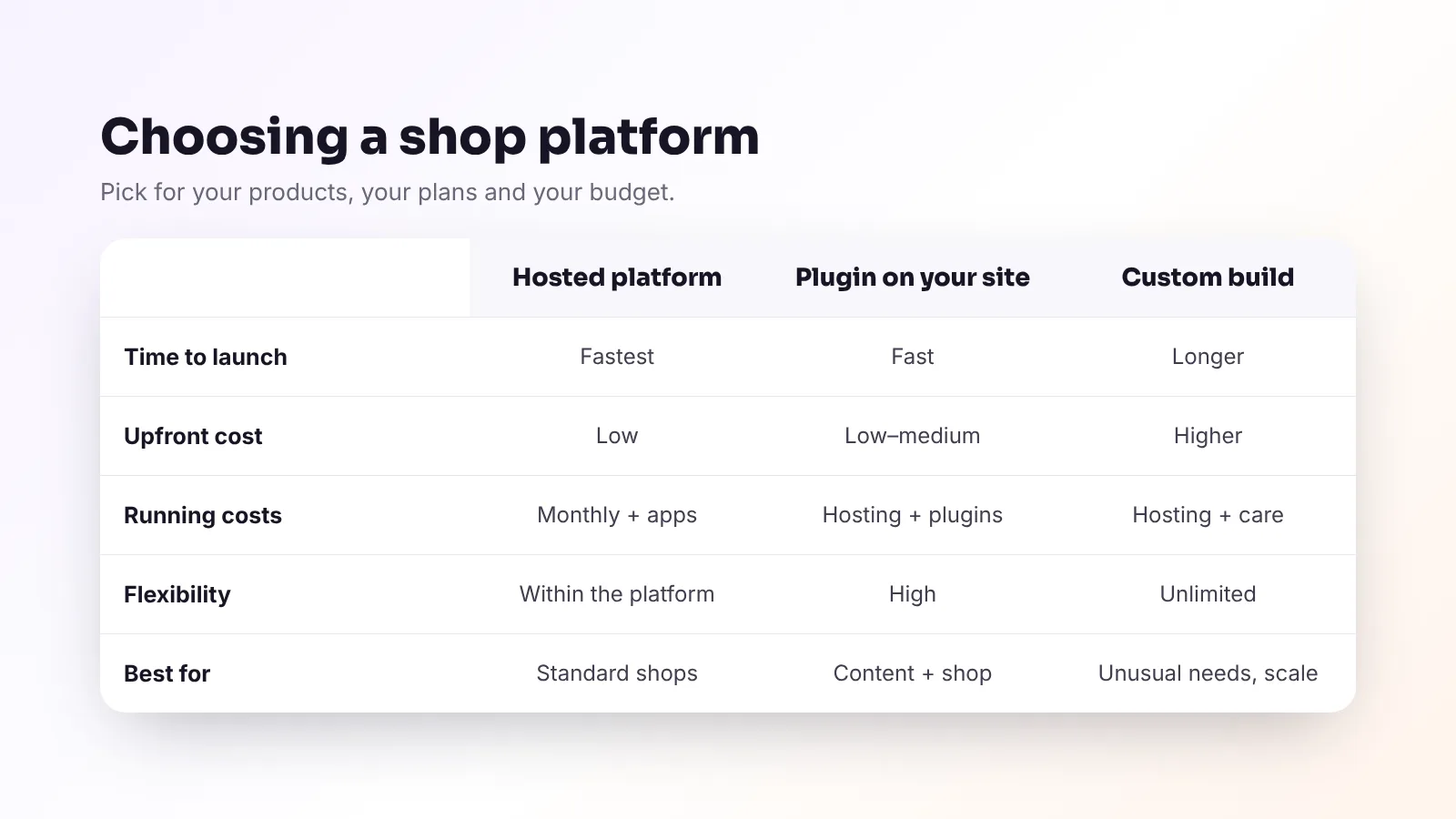
- Hosted shop platforms — quick to launch, secure and maintained for you, with monthly fees and apps for extra features.
- Shop plugins for an existing website — flexible and owned by you, but you’re responsible for updates and security.
- Custom builds — for unusual products, complex pricing, deep integrations or high volumes.
Questions to ask: How many products and variants? Will you sell in several countries, languages or currencies? Do you need to sync with a till or booking system? What are the transaction and app fees at your expected volume?
Step 3: Make product pages that sell
- Real photos from several angles, plus one in use. Our phone photography guide helps.
- Clear titles and descriptions: what it is, who it’s for, size, materials, ingredients, care.
- Price including VAT for consumers, and delivery costs before checkout.
- Stock and delivery times shown honestly.
- Reviews that are genuine (fake reviews are banned in the UK and EU).
Step 4: Payments and checkout
- Offer cards, Apple Pay and Google Pay; consider local favourites in some countries (for example iDEAL in the Netherlands, Bizum in Spain, BLIK in Poland).
- Card payments in the UK and EU are subject to Strong Customer Authentication — your payment provider handles this, usually with a quick confirmation in the customer’s banking app.
- Keep checkout short: guest checkout, address lookup, no unnecessary fields.
- Show trust signals: secure payment badges, contact details, returns policy.
Step 5: Delivery and collection
- Click-and-collect is cheap for you and popular with local customers.
- Local delivery within set postcodes can be a strong point of difference.
- National and international shipping — compare couriers, and be clear about times and costs.
- Free delivery thresholds encourage bigger orders.
Step 6: The legal essentials
This is general information, not legal advice.
- Business details: your trading name, contact details and, for companies, registration details must be easy to find.
- Right to cancel: in the UK (Consumer Contracts Regulations 2013) and the EU (Consumer Rights Directive), consumers can usually cancel distance purchases within 14 days of receiving the goods, with exceptions such as personalised or perishable items. Tell customers how to cancel and provide the information required.
- Terms, privacy and cookies: clear terms of sale, a privacy notice, and consent for non-essential cookies.
- VAT: in the EU, distance sales to consumers in other EU countries above a combined €10,000 a year are taxed in the customer’s country; the One-Stop Shop lets you declare them in one return. UK sellers shipping to EU consumers, and EU sellers shipping to the UK, have separate import VAT rules — take advice.
- Accessibility: the European Accessibility Act has applied since 28 June 2025 to e-commerce services offered to EU consumers. Micro-enterprises (fewer than 10 staff and turnover or balance sheet up to €2 million) providing services are exempt, but an accessible shop sells to more people anyway.
Step 7: Launch and market your shop
- Tell your existing customers first — in store, on social media and by email to those who’ve agreed to marketing (see our WhatsApp and email guide).
- Use Instagram and Facebook shopping features and product tags where available.
- List products on Google through Google Merchant Center so they can appear in Shopping results.
- Run a launch offer with clear terms and real deadlines.
- Consider ads for launches and seasonal peaks (see our ads guide).
Step 8: Measure and improve
Track sessions, conversion rate, average order value, abandoned baskets, returns and repeat customers. Small fixes — better photos, clearer delivery information, a shorter checkout — often lift sales more than more traffic.
Frequently asked questions
What do I need to start an online shop?
Products that work online, a shop platform, a payment provider, delivery or collection options, product photos and descriptions, terms of sale, a privacy notice and a plan to tell customers about it.
Do customers have a right to return online purchases?
In the UK and EU, consumers can usually cancel distance purchases within 14 days of receiving goods, with some exceptions such as personalised or perishable items. Your terms and checkout should explain how.
How does VAT work when selling online to other EU countries?
Once your total cross-border sales to EU consumers exceed €10,000 a year, VAT is charged at the rate of the customer’s country. The One-Stop Shop lets you report and pay it in a single return.
Does the European Accessibility Act apply to my online shop?
It has applied since 28 June 2025 to e-commerce services for EU consumers. Micro-enterprises providing services, with fewer than 10 staff and turnover or balance sheet up to €2 million, are exempt.
Should I use a hosted platform or a custom shop?
Hosted platforms are best for launching quickly with standard needs. Custom builds suit unusual products, complex pricing, deep integrations or high volumes.
The bottom line
A successful online shop is clear products, a quick trusted checkout, honest delivery information and the legal basics — then steady marketing and small improvements. Start focused, launch, learn and grow.
Viraluna Studio designs and builds online shops for local businesses across the UK and Europe — secure payments, stock, delivery and VAT handled properly. Explore online shops or see what a website costs.