Key takeaways
- Organic posts build trust; ads add reach — use them for launches, offers, quiet periods and events.
- Google Search and Maps ads catch people already looking; Instagram, Facebook and TikTok ads create demand with people nearby.
- Start with a clear goal, a tight local area and a small test budget, then put more behind what works.
- In the EU and UK, tracking cookies and pixels need consent; Google has required Consent Mode for EEA traffic since March 2024.
- Ads must be honest and identifiable, and the EU Digital Services Act bans ads targeted on sensitive data or profiling of minors.
Ads can feel like a gamble when you’re a small business: money goes in, and it’s not always clear what comes out. Run well, they’re one of the most controllable ways to bring in new customers — you choose who sees them, where, when and for how much. This guide explains the essentials in plain English.
When ads make sense
- Launches — a new shop, menu, service or product
- Time-limited offers — seasonal menus, sales, gift cards before Christmas
- Events — tastings, open days, workshops
- Quiet periods — fill weekday slots or off-season months
- Recruitment — reaching local staff
- Proven content — boosting posts that already perform well organically
Ads work best when the basics are in place: a complete Google Business Profile, a fast website and good reviews. Otherwise you pay to send people to a weak first impression.
Which platform?
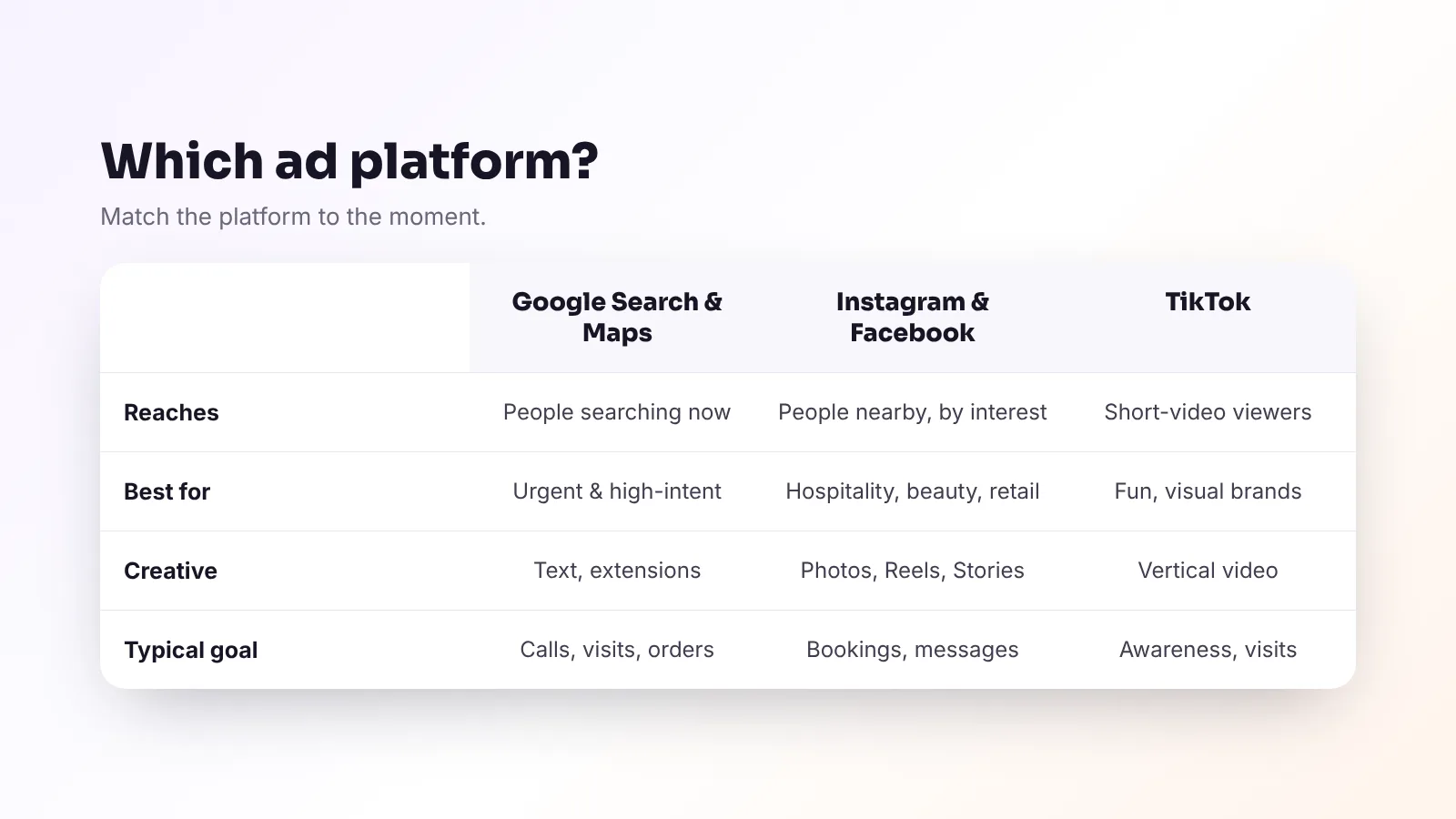
- Google Search and Maps ads — for people actively searching (“emergency plumber near me”, “birthday cake shop”). High intent, usually higher cost per click.
- Meta ads (Instagram and Facebook) — for reaching people nearby by location, age and interests, with images, Reels and Stories. Excellent for hospitality, beauty, fitness and retail.
- TikTok ads — for short, entertaining video, especially for younger audiences.
- Google Local Services Ads — available for certain service categories in some countries, shown at the top of results and charged per lead.
Most local businesses start with one platform, prove it works and then add another.
Targeting locally
- Set a radius around your business or choose the towns and postcodes you serve.
- Target the times people decide (lunchtime for lunch offers, evenings for bookings).
- Use languages that match your customers.
- Build audiences from people who engaged with your page or visited your website (with consent).
- Exclude existing customers when the offer is for new ones.
Budget: how much to spend
There’s no magic number. A sensible approach:
- Pick a goal — bookings, calls, directions, website orders or messages.
- Run a two-to-four-week test with a modest daily budget.
- Measure cost per result — cost per booking, call or order.
- Compare with customer value — if a new customer is worth €60 and costs €15 to win, increase the budget.
- Stop or change what doesn’t work.
Remember that ad spend (paid to the platforms) is separate from any management fee.
What makes a good ad
- Stops the scroll in the first second — movement, a face, a bold result.
- One clear offer — “2 for 1 brunch, weekdays in November”.
- Local — show your street, your team, your customers (with permission).
- Made for the platform — vertical 9:16 video for Reels, Stories and TikTok.
- A clear call to action — Book, Call, Get directions, Order.
- Several versions — test two or three images, videos and headlines.
Our guides on captions that sell and Reels ideas work for ads too.
Tracking with consent
To see which ads bring customers, you’ll use tools such as the Meta Pixel or Conversions API, Google tag and TikTok Pixel. In the UK and EU, these generally count as non-essential cookies or similar technologies and need consent under PECR and the ePrivacy rules. Google has required advertisers using its measurement features for EEA users to implement Consent Mode since March 2024. Use a proper consent banner and respect people’s choices — and track offline results too, such as codes mentioned at the till.
The rules on ads
This is general information, not legal advice.
- Honest ads: prices, offers and claims must be accurate, with conditions stated (UK CAP Code; consumer protection law in the UK and EU).
- Identifiable as ads: if you pay or gift creators to promote you, the content must be labelled as an ad (see our social media rules guide).
- EU Digital Services Act: platforms may not show ads based on profiling using sensitive data (such as health, religion or sexual orientation), or based on profiling to users they know are minors.
- Sector rules: alcohol, gambling, health, cosmetics and financial products have extra advertising restrictions.
- Platform policies: each platform has its own ad policies and may reject ads that break them.
Common mistakes
- Boosting random posts with no goal
- Targeting too wide an area or audience
- Sending people to a homepage instead of the right page
- Judging results after two days
- Ignoring comments and messages on ads
- Running the same creative for months
Frequently asked questions
Are Facebook and Instagram ads worth it for local businesses?
They can be, especially for hospitality, beauty, fitness and retail, when you target a tight local area, use strong creative and measure cost per booking or sale.
Should I use Google Ads or social media ads?
Google Search ads reach people already searching for what you offer. Instagram, Facebook and TikTok ads create demand with people nearby. Many local businesses start with whichever matches their goal and add the other later.
How much should a small business spend on ads?
Start with a modest test budget for two to four weeks, measure the cost per result and compare it with the value of a new customer. Increase spend on what works.
Do I need cookie consent for ad tracking pixels?
In the UK and EU, tracking pixels and similar technologies generally need consent. Use a consent banner, and implement Google Consent Mode if you advertise on Google to EEA users.
Is boosting a post the same as running an ad?
Boosting is a simple form of advertising. A full campaign gives more control over objectives, audiences, placements and testing, which usually produces better results.
The bottom line
Ads work when they have a clear goal, a tight local audience, strong creative and honest measurement. Start small, learn quickly and put your budget behind what brings real customers.
Viraluna Studio plans, designs and manages ad campaigns on Instagram, Facebook, TikTok and Google, with plain-English monthly reports. Explore paid ads or see our social media plans.