Key takeaways
- Local SEO is how you appear when people nearby search for what you offer — on Google Search, Google Maps and increasingly in AI answers.
- Your Google Business Profile is the foundation: complete, verified and updated every week.
- Keep your name, address and phone number identical everywhere they appear online.
- Give each main service (and area, if you travel to customers) its own clear page on your website.
- Reviews, local links and a fast, mobile-friendly website do the rest.
Search “hairdresser near me”, “best pizza in Bath” or “plumber Valencia” and you’ll see the same pattern: a map with a handful of businesses, followed by a list of websites. That top section — often called the local pack — is where most local customers choose. Local SEO is the work that gets you there.
The good news: unlike national SEO, you’re not competing with the whole internet. You’re competing with the businesses near you, and most of them don’t do these things properly.
What is local SEO?
Local SEO (local search engine optimisation) is improving how visible your business is for searches with local intent — searches that include a place (“in Leeds”), imply one (“near me”) or come from someone nearby. Google says local results are mainly based on three things: relevance (how well you match the search), distance (how close you are) and prominence (how well known and well regarded you are).
You can’t move your shop closer to every customer, but you can strongly influence relevance and prominence. That’s what the steps below do.
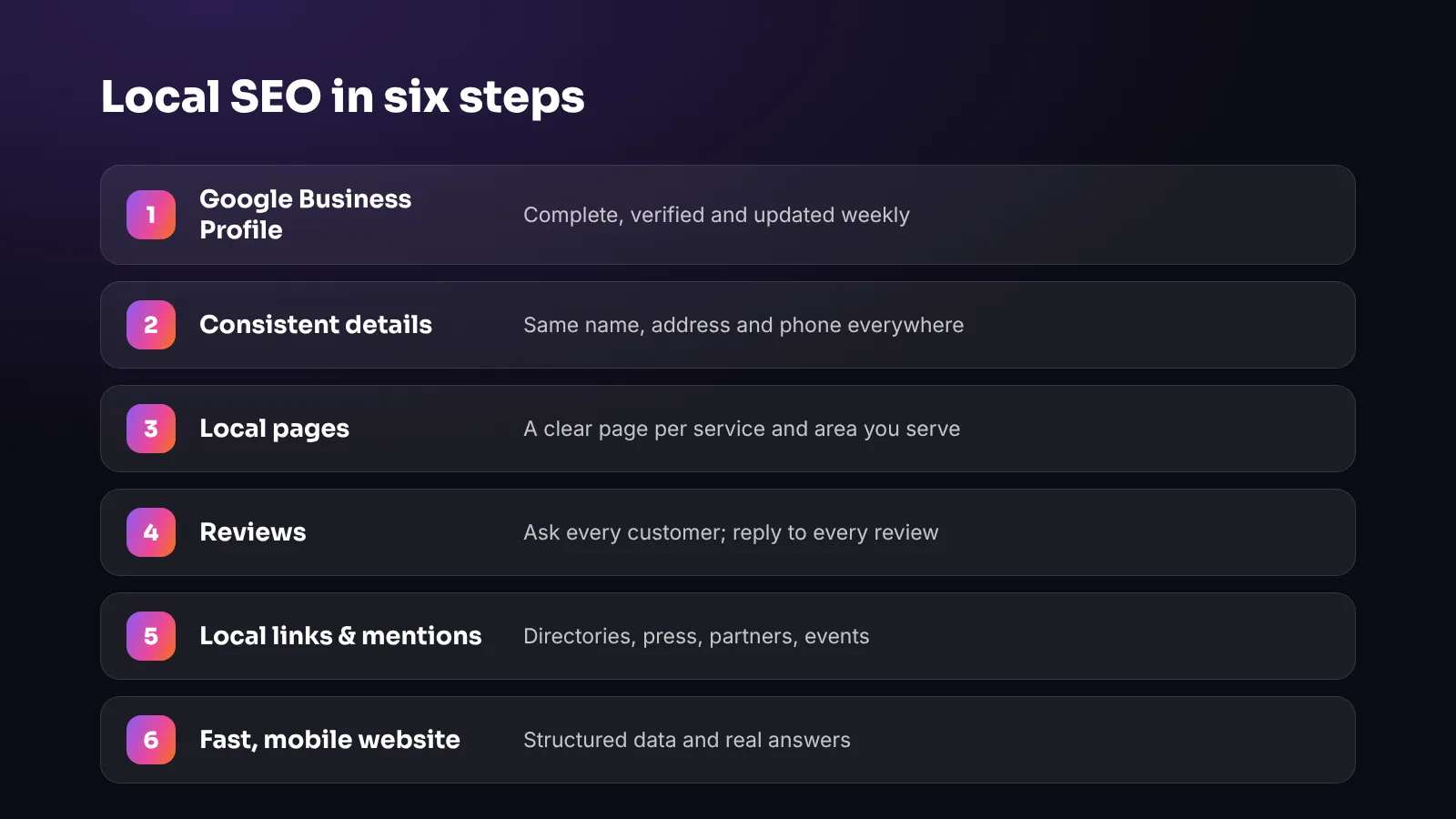
Step 1: Complete your Google Business Profile
This is the single most important step. According to Google’s Business Profile help pages, customers are 2.7 times more likely to consider a business reputable if they find a complete profile on Search and Maps.
Fill in every field: your real business name, the most specific primary category, hours (including holiday hours), phone, website, description, products or services, and at least ten real photos. Then keep it alive with a weekly update. Our Google Business Profile checklist walks through it field by field.
Step 2: Make your details consistent everywhere
Search engines and AI assistants cross-check information. Your name, address and phone number (often shortened to NAP) should be identical on:
- Your website (in the footer and on the contact page)
- Google Business Profile, Apple Maps and Bing Places
- Facebook, Instagram and any booking platforms
- Local and industry directories
Small differences — “St.” versus “Street”, an old phone number, a previous address — create doubt. Search for your business name and phone number, and fix anything out of date.
Step 3: Build pages that match how people search
People search for specific things: “gel nails”, “gluten-free cakes”, “boiler service”. If your website has one page that lists everything, it’s hard for search engines to know which searches you’re the best answer for.
- Give each main service or product category its own page with a clear title, a helpful description, prices or “from” prices, photos and a way to book or enquire.
- If you serve customers in several towns, create a page for each area only if you have something genuinely specific to say — local projects, travel times, area-specific services. Near-identical pages with the town name swapped are low quality and can hold you back.
- Use the words your customers use. If they say “hairdresser”, don’t only say “hair studio”.
Step 4: Earn reviews — and reply to them
Reviews feed directly into prominence, and they’re what customers read before choosing. Ask every customer, make it easy with a direct link or QR code, and reply to every review. Never pay for reviews or only ask happy customers: it’s against Google’s rules and, in the UK, fake reviews have been banned by law since April 2025. Our guide to getting more reviews the honest way explains how.
Step 5: Get mentioned and linked locally
Links and mentions from other trusted local websites tell search engines you’re a real, active part of the community. Good sources include:
- Local business associations, chambers of commerce and town websites
- Local news, blogs and “what’s on” guides
- Event listings for things you host or sponsor
- Suppliers, partners and neighbouring businesses
- Respected industry directories in your country
Aim for relevance over quantity. One mention in the local newspaper is worth more than a hundred links from directories nobody visits.
Step 6: Make your website fast, mobile-friendly and clear
Most local searches happen on phones. Your website should load quickly, be easy to use with a thumb, and show the essentials — what you do, where, when you’re open, prices and how to book — without hunting. Add structured data (schema.org LocalBusiness) so search engines can read your details reliably. Our small business website checklist covers the rest, including Google’s Core Web Vitals.
How to track your progress
- Google Business Profile performance: searches, views, calls, direction requests and website clicks.
- Google Search Console (free): which searches show your website and how often people click.
- Real outcomes: bookings, calls and “I found you on Google” at the counter.
Local SEO builds steadily. Most businesses see the first improvements within weeks of fixing their profile and details, and stronger results over a few months of consistent reviews and content.
Frequently asked questions
How long does local SEO take to work?
Fixing your Google Business Profile and inconsistent details can make a difference within weeks. Building reviews, local mentions and better pages is ongoing, with stronger results over several months.
Do I need a website for local SEO?
You can appear in Google Maps with only a Business Profile, but a good website makes you far more competitive. It gives search engines and customers more information and gives you pages that can rank for specific services.
What does “near me” mean for SEO?
When someone searches “near me”, Google uses their location to show nearby businesses. You don’t need to write “near me” on your website; you need a complete, accurate profile and clear pages about what you offer.
Is local SEO different in the UK and Europe?
The principles are the same. Use the language your customers search in, list your business on the directories that matter in your country, and make sure your address format and phone number match local conventions.
Can I do local SEO myself?
Yes. The steps in this guide are all things a business owner can do. The hardest part is consistency: updating the profile, asking for reviews and improving pages every month.
The bottom line
Local SEO isn’t magic. It’s a complete Google Business Profile, consistent details, clear service pages, a steady flow of genuine reviews, a few good local mentions and a fast website — kept up month after month.
If you’d like it done for you, Viraluna Studio’s SEO & GEO service covers local SEO from your profile to your website, and our social media plans keep your profile active every week. Ask for a free quote.